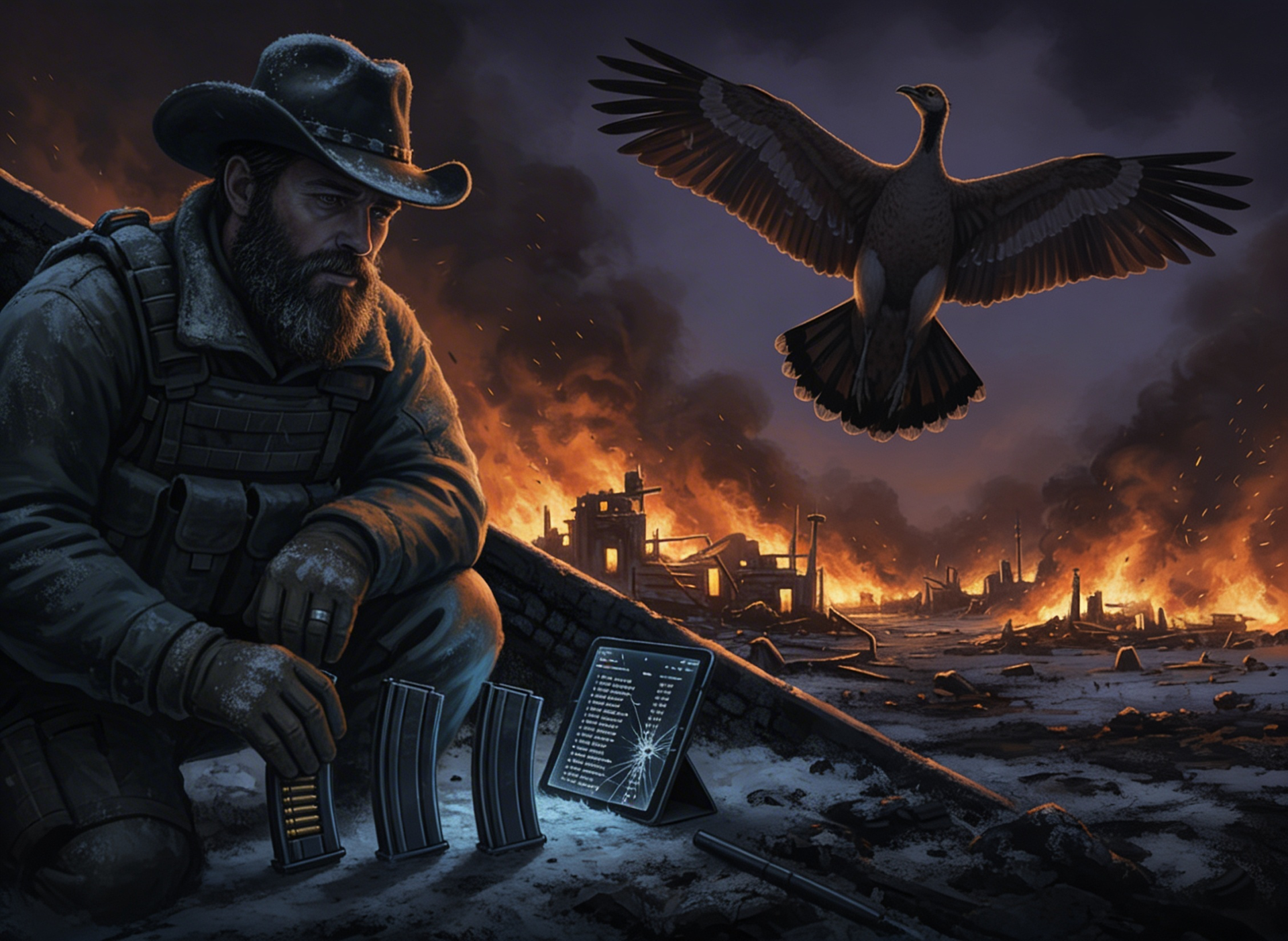
Forty-Five Seconds
“Forty-Five Seconds” operates as a chapter of violent convergences — between civilian vulnerability and military force, between individual conscience and institutional betrayal, between the beauty of the natural world and the ugliness of what humans do to one another.
The chapter opens with Taras Myroslav, a Ukrainian shopkeeper who, days earlier, was balancing ledgers, now being driven at rifle-butt through rubble alongside companions Petro and Vasyl. Their destination is a fortified building where Colonel Ivanov — immaculate, medal-heavy, and utterly cold — conducts a methodical interrogation that is really an execution by degrees: accusations of contact with Americans, denials answered with blows, a tooth skittering across the floor, bones broken over hours. The scene closes with Taras taken to a garden just as a Great Bustard — twenty-one kilograms of muscle and wing — erupts from the steppe in a thunderclap of life. Taras faces a wall—the shadow of helicopters circles above his fallen body. The author gives us no commentary; the contrast does the work.
The narrative pivot to Sergeant “Blaze” Montgomery and his Ranger unit is abrupt by design — Ivanov’s name on Blaze’s lips before the village below has even come into full focus. The team surveys the aftermath: charred buildings, civilian dead, and a little girl cradling a fire-damaged teddy bear whose synthetic fur has melted. For Blaze, raised in Houston’s hardest neighborhoods, where children also learned to duck from gunfire, the image is not abstract. It is personal. This chapter’s emotional engine — everything that follows, however kinetic, derives its urgency from that small figure in Atlas’s arms.
The assault on Ivanov’s compound is a masterclass in controlled chaos. Blaze’s team exploits an electrical storm to blind the enemy’s electromagnetic defenses, breaching the perimeter only to find their intelligence catastrophically incomplete. An uncharted pillbox scatters the unit; communications collapse; patrols multiply. Isolated and outnumbered, Blaze retrieves a tablet from a dead enemy soldier and discovers the mission’s true wound: thirty undercover operatives compromised, their families listed, and evidence of a traitor embedded in his own ranks. The chapter title resonates most precisely here — not in the combat countdown, but in the inventory ritual that precedes it—forty-five rounds across three magazines: nine, fifteen, twenty-one. Blaze counts and recounts each one, maps their order (fullest forward, depleted rear), and feels his wedding band click against metal. The passage is the chapter’s quietest and most resonant — survival reduced to arithmetic, duty reduced to forty-five chances.
Ramsey’s broken-voiced transmission from somewhere in the dark refuses to let Blaze surrender. He invokes the villages, the children, the oath. Blaze straightens. The chapter closes mid-battle, with Singh retrieved, intel secured, and Blaze calling Ramsey in for one last coordinated strike — the outcome uncertain, the commitment absolute.
Stylistically, the writing earns its intensity through embodied, sensory prose rather than abstraction: copper taste, acrid fumes, the scrape of a rifle butt against the spine. Blaze’s Texan idiom — cowboys, longhorns, twisters — initially risks tonal incongruity against the Ukrainian setting, but ultimately functions as characterization: a man who imposes familiar language on unfamiliar horror as a psychological anchor. The chapter’s central tonal achievement is holding elegiac grief and tactical urgency in the same frame without letting either collapse the other.