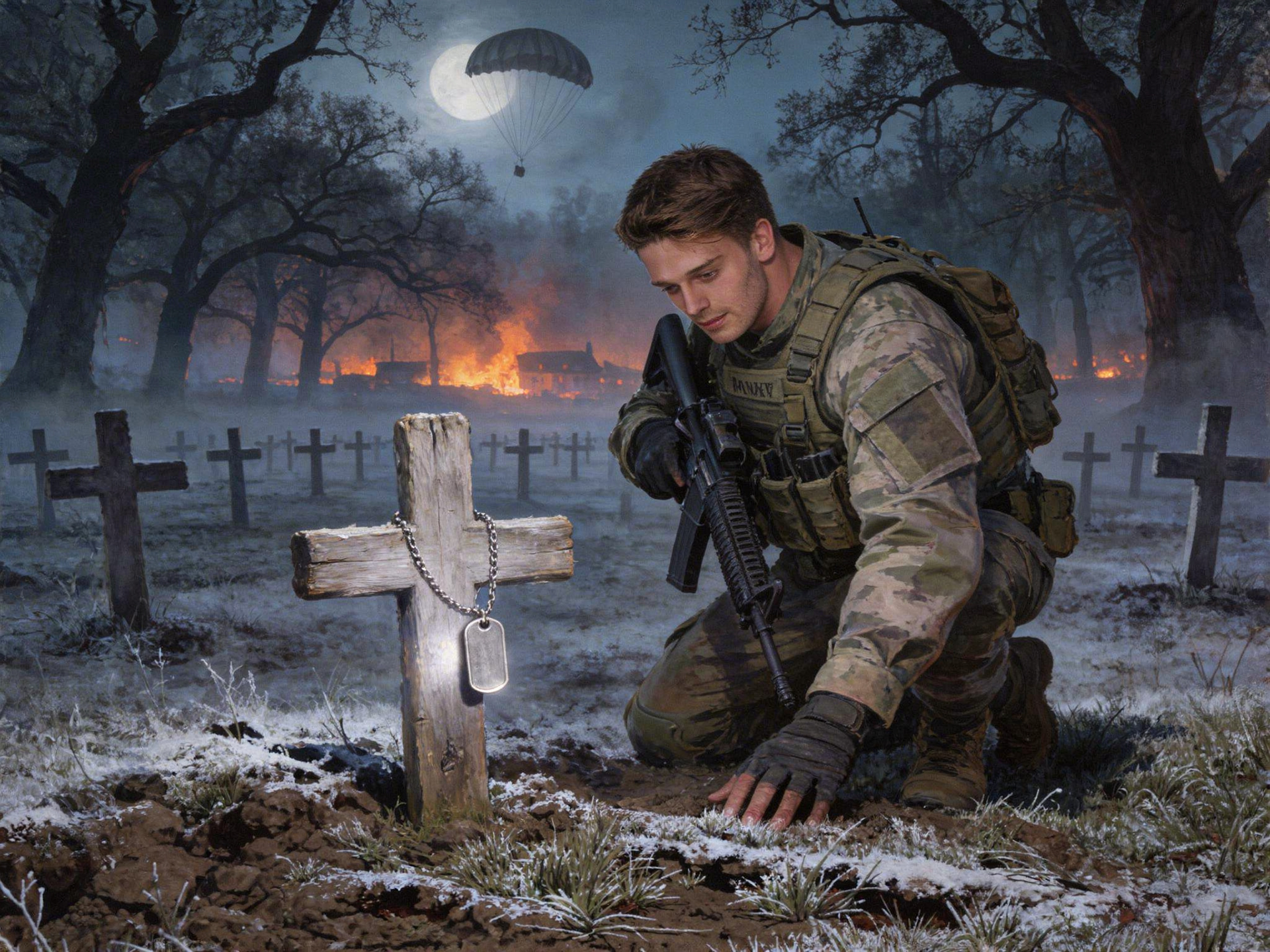
Unmarked Graves
“Unmarked Graves” drops the reader into the controlled chaos of Fort Benning, where Second Lieutenant Blaze Montgomery — a Ranger officer navigating the gap between schooling and command — receives urgent orders that will test every dimension of his leadership. Colonel Phineas Hartman briefs the assembled team with barely contained urgency: Colonel Popov Ivanov, the “Butcher of Ozera,” has re-emerged near the Ukrainian border with a trained force threatening catastrophic violence. The briefing is double-edged — Hartman issues the mission while simultaneously dissecting Blaze’s every micro-expression, establishing early that command is also performance, trust perpetually audited.
Before deployment, a training incident crystallizes the chapter’s emotional stakes: Blaze catches Private Jasper “Sunrise” Lee mid-fall from a snapping harness, holding on through raw muscle and refusal. The near-loss lodges in Blaze’s chest as a template for what command demands — the responsibility not to let go. Aboard a C-17, CIA operative Gordie Orwell reframes the mission psychologically: Ivanov’s ego is his vulnerability, and defeating a monster requires understanding the man beneath the myth. This intelligence shifts the operation from straightforward elimination toward something more nuanced and dangerous.
The insertion into the Crimean/Serebriansky forest immediately fractures — tracer rounds tear through the night sky, the team scatters, and the mission clock accelerates. On the ground, Blaze’s tactical judgment is tested when a ragged band of Ukrainian civilian fighters, led by the quietly ferocious Taras Myroslav — a man whose family Ivanov murdered — emerges from the trees. Blaze weighs the risk of trust against the intelligence advantage these survivors represent and extends a cautious alliance, a decision that underscores the chapter’s secondary theme: sometimes the decisive act is choosing to listen.
The chapter’s final movement is its most visceral. The assault on a Spetsnaz outpost erupts into a chaotic, smoke-choked firefight, mortar fire, hidden bunkers, and rooftop snipers. When soldier Atlas is shot in the leg and begins to bleed out, Blaze abandons cover to reach him, performs emergency field triage under active fire — tourniquet, hemostatic packing, Israeli bandage — his hands working through combat instinct and something closer to love. The chapter closes with both men in the treeline, breathing hard, alive. Not victory — survival, and the knowledge that the mission is far from over.
Stylistically, the author deliberately modulates sentence rhythm: short, staccato bursts mirror gunfire and adrenaline; longer, tactile passages slow time during introspection and connection. The forest sequences are the prose’s strongest register — organic, paranoid, and claustrophobically sensory. The chapter’s dominant tones are moral urgency and controlled dread, leavened by genuine warmth between soldiers whose lives depend on each other. Ultimately, “Unmarked Graves” is a chapter about the cost of command — not its glory — and the human beings who shoulder it.